Origin
In 1854, Florence Nightingale arrived at Scutari military hospital outside Constantinople. The Crimean War was eighteen months in. British soldiers were dying at rates no one fully understood. She was thirty-four years old.
She began with the ward. Then she began to count.
By the time she returned to London she had compiled the most complete mortality record any army had ever produced. The numbers showed that most of the deaths were not from battlefield wounds. They were from preventable disease in the hospitals themselves. Typhus, dysentery, cholera. Cleanable, treatable, avoidable.
She knew the figures alone would not be enough. So in 1858 she drew a chart. A polar area diagram. Blue wedges for preventable disease. Red for wounds. Black for everything else. The blue wedges swallowed the page.
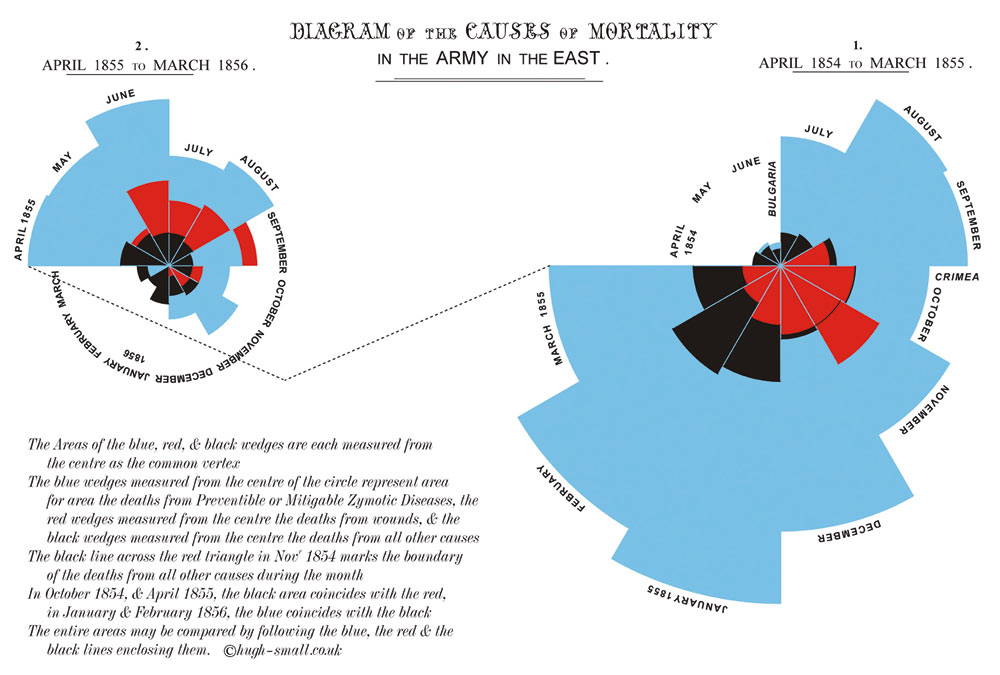
Wounds killed soldiers. That was the accepted truth of war, so the money, the attention, and the effort went to the battlefield. The real killer, preventable infection inside the hospitals themselves, was invisible, and no one was working on it.
The chart ended that. Once leadership could see that disease was taking more men than battle, the effort finally went where the dying actually was.
One observation, made visible, turned an entire institution toward what needed fixing. Sanitation reform passed within years. Field hospital design was rewritten. The casualty figures of every war that followed were lower because of what she had shown.
It is the founding artifact of healthcare data visualization. It proved that the way information is presented decides whether it gets used.
The firm takes its name from her. Florence in Italian. We work in the same tradition: showing senior leaders the data that already exists, in the form that makes it impossible to ignore.
The work
Camilo Barcenas's career has carried that principle forward through specific moments.
Eighteen years ago, he led the first enterprise PACS in healthcare. Radiology moved from X-ray film pulled out of physical folders to digital images viewable across an entire health system. Doctors saw what they needed, where they needed it.
Soon after, he led the first implementation of virtualized storage in healthcare. Patient records moved from manila folders to screens, available where the decisions were being made.
Then he served on a federal Standards and Interoperability Framework committee, digitizing the historical record so what one health system knew could move to the next.
In 2011, he founded Dabo Health, the most direct descendant of Florence's chart. The polar area diagram, redrawn for hospital quality metrics, deployed to 300+ hospitals. The Mayo Clinic cardiology deployment produced a 48 percent improvement in patient satisfaction scores within four months.
At Stanford Health Care, he led technology integration on the $2B 500P adult hospital activation, an 824,000 square foot facility serving 10,000 daily users. Delivered on schedule.
The push has always been one push. Make the information available to the people who need it to save lives. Get the technology out of the way so humans can operate at the human level.
In the AI era, this matters more, not less. The technology grows more capable. The information grows richer. The gap between data and decision can either close or widen.
That is the work.
The same principle now extends from making data visible to making it valuable: the Data as a Strategy practice stands up the business model around the data assets institutions already own.
Firenze works with senior leadership across healthcare: academic medical centers, health systems, clinical and research labs, and the technology platforms that serve them. The practice covers data strategy, facilities technology, AI integration, capital project delivery, the operating governance that connects them, and the data visualization layer that makes the work visible at the institution or embedded inside partner platforms.
Programs run over multiple years, sized to institutional ambition. The firm engages across IT, engineering, clinical operations, vendors, and executive leadership, staffing senior partners into the rooms where the decisions get made.
Senior partners stay with each engagement through delivery and into the next phase of work.
Founder
Camilo Barcenas
Camilo Barcenas is a two-time healthcare technology founder with nineteen years building companies and operating inside the largest health systems in the United States.
From 2016 to 2020, he was senior technology consultant on Stanford Health Care's $2B new adult hospital activation, the 500P project, an 824,000 square foot facility serving 10,000 daily users. He led technology vendor coordination and healthcare procurement across clinical engineering, IT, construction, R&D, legal, compliance, and executive leadership, and delivered the facility on schedule.
Before Stanford, he founded Dabo Health, an enterprise SaaS platform for hospital quality improvement developed with The Mayo Clinic. The company scaled to 300+ hospitals across the United States and was acquired by Safeguard Scientifics. The Mayo Clinic cardiology deployment produced a 48 percent improvement in patient satisfaction scores within four months.
During the same period, he served as Program Manager for Meaningful Use Stage 1 at Kaiser Permanente, managing federal electronic medical record compliance across eight national regions, and on a federal Standards and Interoperability Framework committee shaping national interoperability standards for electronic medical records.
Earlier in his career, he served as Director of Healthcare Technology at Mazzetti, where he managed $8M+ engagements, and as Technology Lead, Healthcare at Jones Lang LaSalle, where he contributed to Kaiser Permanente's $25B ten-year national facilities plan and was rated firm-wide as a Tier 1 performer.
Education
- Stanford University Graduate School of BusinessThe Innovative Health Care Leader (Executive Program)
- Boston UniversityMSM, International Commerce, Valedictorian
- Randolph-Macon CollegeBA, International Relations & Economics
Recognition
Acquisitions and outcomes
Dabo Health acquired by Safeguard Scientifics. Mayo Clinic cardiology deployment documented in published outcomes, with a 48 percent patient satisfaction improvement in four months. Spry Health, an angel investment, acquired by Itamar Medical.
Standards and advisory
Federal Standards and Interoperability Framework committee member. Advisor, UC Berkeley SkyDeck Healthtech Accelerator. Stanford GSB executive program graduate.
Publication
Quality Metrics: Data Transparency and User-customized Design Drive Frontline Engagement.